When prospective buyers visit your listed home, the room they tend to check out most closely is the kitchen. So, it pays to ensure it looks its best.
However, no matter how tidy, clean, and well-adorned you’ve made your kitchen, there are some issues — which can seem minor — that can distract a buyer from appreciating those positive qualities.
Here are just a few to watch out for:
Stained sink. Use a specialized cleaner for the type of sink you have. (For example, Stainless Steel Sink Cleaner.)
Garbage in the garbage bin. Buyers don’t mind seeing the bin, just not garbage in it! Don’t forget to also empty the organic waste bin.
Left-overcooking scents. Avoid cooking anything prior to a viewing that may create lingering odors. For example, not everyone appreciates the aroma of spaghetti sauce!
Cluttered countertops. You want the countertops to look spacious to buyers. So remove any items that don’t absolutely need to be there.
Old or worn mat in front of the sink. Replace it.
Cluttered or disorganized cupboards. Declutter and organize your cupboards. Buyers are most likely to open upper cabinets.
Poor lighting. You want the lighting in your kitchen to be bright (but not blinding) and evenly distributed.
Damaged or stained countertops. Replacing your countertops can improve your kitchen’s look considerably, so it might be worth the investment.
Would you like more suggestions on how to stage your home so that it gains the interest of buyers? Contact us. Call today!
Canadian Housing Starts (May 2023) – June 19th, 2023
Canadian Housing Starts (May 2023) - June 19th, 2023
Canadian housing starts fell 23 per cent to 202,494 units in May at a seasonally adjusted annual rate (SAAR). Starts were down 28 per cent from the same month last year. Single-detached housing starts rose 3 per cent to 55,967 units, while multi-family and others fell 29 per cent to 146,528 (SAAR).
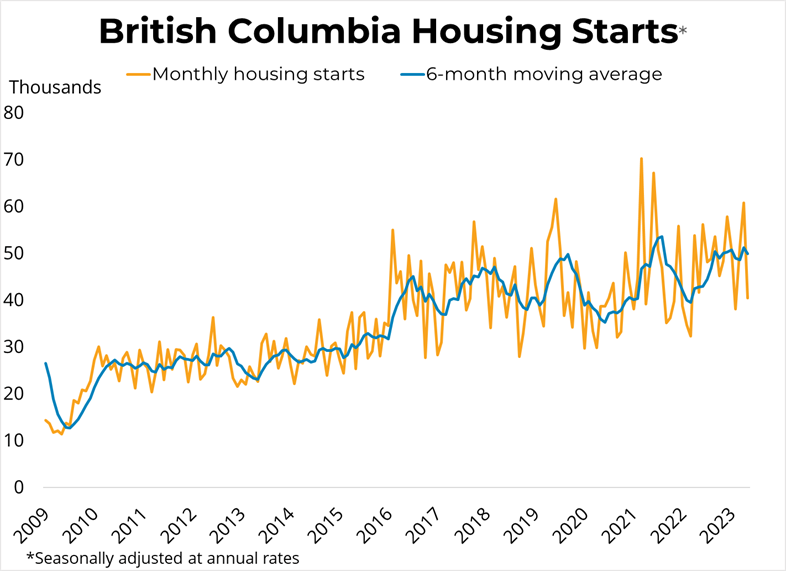
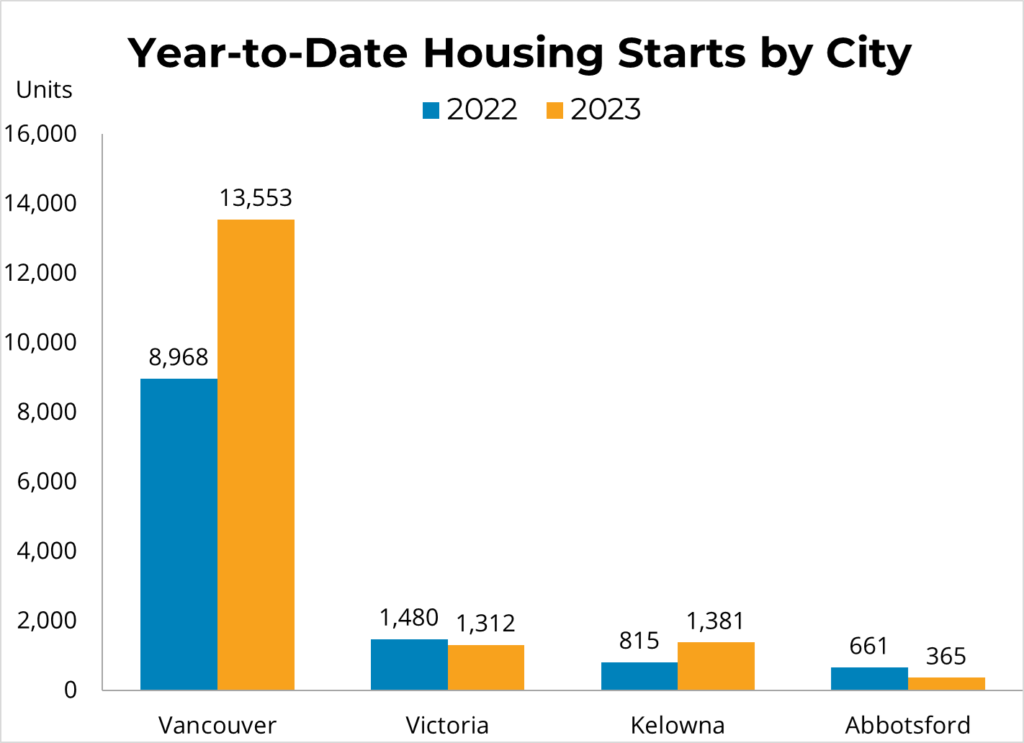
In British Columbia, starts fell by 33 per cent in May to 40,536 units SAAR in all areas of the province. In areas in the province with 10,000 or more residents, single-detached starts rose 7 per cent m/m to 6,207 units while multi-family starts fell 39 per cent to 32,010 units. Starts in the province were 3 per cent below the levels from May 2022. Starts were down by 22k in Vancouver, while rising by 0.6k in Victoria, 0.6k in Kelowna, and 1.7k in Abbotsford. The 6-month moving average trend fell 2.6 per cent to 49.9k in BC in November.
Understanding How your Local Market Works
Understanding How your Local Market Works
When you read or watch the news about the real estate market, it may seem reasonable to make the assumption that the information applies equally to your street or community.
But, that isn’t always true.
In fact, the characteristics of your local real estate market can differ in many respects from the regional or national market. Say the regional real estate market is most active during certain months of the year. That might be true of your neighbourhood, too. But, there may also be some caveats. If, for example, buyers are eagerly awaiting listings to come up in your community, then that micro market might heat up faster than other areas in the region.
Knowing how your local market works and how it differs from the larger regional market is crucial when selling. It helps you decide when it’s best to list and helps to ensure your home sells quickly and for a good price. That’s a strategic advantage.
Understanding the local market also helps when buying. Imagine acting only on regional or national market statistics without knowing the unique market characteristics of a neighbourhood you’re hoping to buy into. You could end up missing opportunities. You don’t want that!
So, pay attention to the local real estate market. Get the latest information on what’s happening.
Upsizing or Downsizing? Don’t Overdo It!
Upsizing or Downsizing? Don’t Overdo It!
Imagine you have a growing family, and you want to trade in the small sedan for something larger. So, you visit the dealership and come back with a bus.
Well, that would be upsizing a bit too much – unless you have a really huge family!
That’s the challenge of upsizing or downsizing. You need to be careful not to take it too far and end up with something that isn’t suitable.
This often occurs in the real estate world. For example, homeowners might decide to sell their home and find a smaller one. But, if they go too far, they end up with a property so small they feel claustrophobic.
How do you avoid a similar scenario happening to you?
If you’re thinking of upsizing or downsizing, the best place to start is in your own home. Think about how you use the space. Do you and your family spend a lot of time in certain areas? Are there rooms and other spaces that are rarely used? Or, conversely, do you wish you had more room — such as an extra bedroom, wider driveway, separate living and family rooms, etc.?
Do a thoughtful analysis of how you’re using your current property in order to reveal clues about what you’ll want in your next home. If you’re upsizing, you might find that all you need is an extra bedroom. If you’re downsizing, you might realize that one family room, rather than separate living and family rooms, would work better for you.
So, whether you’re upsizing or downsizing, carefully decide what type of new home you need. Be as specific as possible. Consider criteria such as the number of bedrooms, entertaining space, bathrooms, driveway size, etc., that you need. Doing that will help ensure your upsizing or downsizing move will be successful.
Getting Ready for OPEN HOUSE Day
Getting Ready for OPEN HOUSE Day
When you’re selling your property, hosting an Open House will provide an opportunity to attract buyers. So, what can you do to prepare for the day? Here are a few suggestions:
Make sure the entire house is clean and tidy. Think of making it “guest ready.”
Plan to leave early and come back late. Recognize that people may not arrive nor leave precisely on time.
If possible, remove pets. Take them to a friend’s house or pet daycare.
If you’re concerned about valuables (such as jewelry), lock them somewhere safe. For example, you can hide them in the trunk of your car.
Avoid cooking the morning of an Open House. The odors may linger.
Provide ample space by the front entrance for shoes and boots.
If possible, avoid having any deliveries that day.
Make sure interior doors are unlocked, including the door to the garage. Finally, resist the urge to “drop by” and see how things are going. Instead, take the time to do something enjoyable, such as an outing to the park or mall. Want more ideas for selling your home quickly and for top dollar? Call today.
Advantages of Buying a House that Needs Work
Advantages of Buying a House that Needs Work
There’s no doubt about it. Buying a home that is “move in ready” is a real convenience. All you need to do is get your belongings in place, and you’re ready to enjoy living in your new home. You don’t even need to paint. That’s why move-in-ready homes tend to attract more buyers.
However, there are advantages to buying a property that needs work. And, if you’re currently shopping for a new home, a listing that requires some repairs, upgrades, or renovations might be worth considering.
Why?
Properties that need work tend to be priced lower than comparable move- in-ready listings. Depending on market demand, the price savings can range from modest (just a few thousand dollars) to substantial.
Also, homes that need work tend to attract fewer buyers and offers, so there’s less competition.
Another advantage is the opportunity to get into a desirable area you otherwise might not have afforded. It might be worth the extra work you’d need to put into the home to live in your dream neighbourhood.
But, while there are advantages, there are also important caveats.
The first caveat is you must know the scope of work that is required before making any decision to purchase. How will you get the work done? How much will you need to budget for the improvements? Are you prepared for the realities of living in a property during renovations?
The second caveat is you must anticipate any issues that can’t be seen during a typical viewing. The last thing you want is to pay for a major repair you weren’t expecting. That’s why getting a professional home inspection as a condition of your offer is often a good idea.
There’s a lot to think about when you’re buying a “needs work” property. But, I can help you make an informed decision. Call today.
Environmentally-Friendly Ways to Dispose of Items
Environmentally-Friendly Ways to Dispose of Items
When you’re preparing your home for a sale, you should declutter as much as possible. That makes your property appear neater and more spacious to buyers.
However, that doesn’t mean you have to toss items in the trash or haul them to a landfill site. There are many other, more environmentally-friendly ways to dispose of unwanted items.
One popular technique is to sell them online. Even if you think an old chair isn’t worth much, as the saying goes, “One person’s junk is another’s treasure.” There are several websites for selling items quickly, including Facebook Marketplace. In fact, you can list items today and potentially sell them this week. Just be sure to set prices low, as people tend to look for deals on these sites.
You can also give away items. Post items you’re willing to part with for free on your community’s Facebook page. You can also pin a poster to an announcements board in your neighbourhood.
Donating items is also an option. There are many charities that accept items such as clothes, furnishings, tools, kitchenware, and sports equipment. Google “Where to donate items” and then add the name of your area.
Finally, an old-fashioned garage or yard sale can be effective. Place signs throughout your neighbourhood announcing the sale. Start your sale early. Many hardcore garage sale lovers will be there as soon as you open, even if that’s 7am!
Want more advice on how to prepare your home for sale? Call me.
Revisiting Previously Unaffordable Neighbourhoods
Revisiting Previously Unaffordable Neighbourhoods
Imagine you’d been keeping your eye on a desirable neighbourhood over the years. You had hoped that one day you could buy a home there. But, then you saw prices creeping up — to a point where they became unaffordable.
“Oh well,” you’d thought. “I guess we won’t be moving there!”
That scenario is familiar to many homeowners. In fact, you too may have been keeping your eye on a neighbourhood you’d love to get into but have decided it’s become too expensive.
If that’s so, it might be worth taking a second look.
The real estate market changes. One year an area might be a red-hot seller’s market with prices soaring. The next year, things may have cooled, and prices stabilized.
That means the desirable neighbourhood you’ve been coveting might, today, be more affordable than you think. Prices might have become more reasonable. There might be more inventory (more homes for sale), giving you, the buyer, a competitive edge.
And, don’t forget that your own property may have gone up in value, perhaps considerably. That means the money you make from selling your home may make buying in the desirable neighbourhood doable.
It’s something to think about!
So, if you’re dreaming of getting into a particular neighbourhood, don’t make assumptions about affordability. At least, not yet. Find out the current state of the market. You might be delighted to learn that the “un” has been dropped from the previously unaffordable for that area!
Want to learn more? Call today.
Fix it? Or leave it “as is”?
Fix it? Or leave it “as is”?
Whenpreparing your property for sale, you want to make it as attractive as possible to buyers. After all, the more buyers like what they see, the higher the probability you’ll get good offers.
That’s why it’s advisable to clean, declutter, decorate, fix, and improve as much as possible.
But, how far should you go with fixing and improving? For example, should you tear down the old deck and build a new one? Or, should you leave itas is?
Should you paint the main floor? Or is it okay to leave the faded finishand few wall dents just as they are?
Those can be difficult questions to answer because many factors come into play.
•What is the traditional return on investment for that home improvement?
(In other words, how much will you get back when you sell?)
•To whatdegree will the fix or improvement help sell your home faster and/or for a higher price?
•If you don’t make the fix or improvement, will those deficiencies be likely to dissuade buyers who would otherwise be interested in buying your property?
•What are thecurrent market conditions? Are there other listings in the area competing with yours?
•How much will the fix or improvement cost? Is it affordable, given the benefits of having a listing that’s more attractive and move–in ready?
Once you have answers to those questions, you’ll have a clearer idea of whether to fix it or leave itas is.
I can help you get those answers. Call today.
Showcasing the Unique Features of your Property
Showcasing the Unique Features of your Property
Imagine you’re at the grocery store shopping for oranges. Two brands are available: the “Amazing Orange” and the “Super Orange.”
Which would you choose to buy?
Chances are, you wouldn’t decide based on their similarities. For example, since both oranges contain vitamin C, using that as a buying criteria wouldn’t help you choose between them. Instead, you would probably look for differences. What does one brand have that the other does not? Maybe one is less expensive, organically farmed, or is seedless!
When people make buying decisions, they often look for differences.
So, if you’re thinking of selling your property, highlighting its unique and desirable features—its differences from comparable homes—is crucial.
How do you do that?
The first step is to make a list of those special features you want buyers to notice. Those might include a new and spacious deck, extra high ceilings, a finished basement, move–in readiness, and other characteristics.
Next, you want to make sure those features are emphasized in marketing materials and when staging your home.
There are many ways to emphasize features through staging. For example, if the deck is a desirable feature, ensure it’s well–lit in the evenings (for after–dusk viewings.) Also, make it easy to see when buyers are in your home, by having the curtains pulled back. You may be able to explore other ways to ensure buyers notice and appreciate the deck too.
Differences make a difference! Show them off when selling.