Selling a fixer-upper property can be challenging, but the process can be made a lot smoother by making some smart decisions:
Hire a REALTOR® with a proven track record of selling fixer-uppers. You need a REALTOR® who knows how to market your property to potential buyers. When interviewing agents, ask for past examples of fixer-upper sales.
Decide if it’s worthwhile financially and timewise, to repair or renovate before selling.
Determine if you will sell it “as-is.” Doing so will limit liability for issues, such as broken appliances, mould, pest issues, etc.
Choose whether it makes the most sense to stage, not stage, or leave the property vacant.
If it’s not going to be a complete gut job, have it professionally cleaned.
Price it right. Check out what recent fixer-uppers in your area have sold for and determine the lowest price you will accept.
Be sure to market to builders and contractors. Focus on the potential and selling points (e.g., layout, desirable location, original wood), be transparent about any issues to avoid liability, consider mentioning cost estimates for renovations, and try to time your selling with when the weather is more agreeable for renovations.
Selling a fixer-upper might take longer than your average property sale, but with some patience, optimism, and a solid strategy it can be done.
How to Avoid a Mortgage Scam
How to Avoid a Mortgage Scam
Scams are everywhere just waiting for you to take the bait if you aren’t careful. For many homeowners, their home is their biggest asset, so dodging a mortgage scam takes on extra importance. These scams can take the form of false promises for better mortgage terms, wire fraud phishing schemes during the closing process, stealing your home equity with reverse mortgages, loan flipping (where the borrower is persuaded to repeatedly refinance the same loan so the lender can collect fees) and more.
To avoid being a mortgage scam victim, read on for some helpful tips.
Shop around for qualified lenders. Check their status on the Better Business Bureau website.
Your mortgage payment should not exceed 28 to 32 percent of your gross monthly income depending on the lender. If you have a lender that approves you despite this, run the other way.
Never give money to a lender without a contract.
Don’t divulge personal or banking information in response to unsolicited mortgage offers.
Always read the fine print on any documentation and understand the terms before signing.
Monitor your credit report for any unauthorized transactions.
Don’t work with lenders who discourage you from talking to a financialprofessional or lawyer.
Avoid lenders who bully or try to pressure you.
For one final word of advice, be weary of offers that seem too good to be true. As the saying goes, “If something sounds too good to be true, it probably is.”
Freeze the Stress: Winter Moving Tips
Freeze the Stress: Winter Moving Tips
Getting ready to move this winter? While it may not be as easy a move as in other seasons, with a little preparation you can accomplish a move that goes off without a hitch. For some helpful tips, read on.
Be prepared to be flexible – Check the weather in the days leading up to your move. If a storm is forecasted for your moving day, consider rescheduling your move date. Get any pre-move errands completed in advance of your move, so you don’t get stuck trying to accomplish them in bad weather at the last minute.
Prepare both homes for winter moving – Ensure both your old and new homes have clear, wide paths for moving, plastic sheeting to protect floors, and if it will be dark during any part of your move, check that the exterior lighting works, and consider headlamps.
Protect belongings – Temperature changes from the warmth of your home to the cold of the moving truck can cause items like glass to break and electronics to malfunction, so secure these items according to the manufacturer’s instructions and have them loaded onto the truck last or transport them in your own vehicle to keep a closer eye on them.
Organize utilities – Schedule utility hook-up at your new home before you move so you aren’t stuck without the ability to control indoor temperatures in the height of winter.
Prepare your vehicle – Especially if you are making a long-distance move, make sure your vehicle has been serviced recently and is stocked with gas, washer fluid, first aid and emergency kits, and blankets.
Show your movers some appreciation – A warm drink and something to eat for your movers will be a nice gesture to show you care.
Don’t let Mother Nature make moving more stressful than it needs to be, and plan ahead if you have a winter move coming up.
Before You Make a Move: Weighing It All Out
Before You Make a Move: Weighing It All Out
Deciding when to move can be a tough decision. If you are thinking about moving, consider the following:
Length of time living in your next home – Would you be there long enough to recoup the initial costs of moving, such as the down payment, closing fees, and moving expenses?
Mortgage penalties – Try to align selling with when your mortgage is up for renewal to avoid a penalty, or negotiate it with your lender. You may also have the option to port your mortgage and take on a blended rate combining your old interest rate with the new one.
Your job situation – If you don’t have a secure job this could be an obstacle with a lender.
Non-monetary costs – Would you be moving mid-way through your child’s school year, or would they have to give up the sports team they are on if you moved? Consider disruptions to your routine and social connections, along with other stresses in your life, to determine if it’s the best time to move.
Plans for the new home – Do you have plans for what you would want to do with your new home, and might there be any restrictions on what you can do (e.g. do you intend to renovate it, run a business out of it, or use it as a short-term rental)?
Your future plans – Would your new home have enough space for your family or future family, including pets? Consider which schools are nearby if you have kids or plans to start a family.
Your day-to-day life – Consider the neighbourhood you would want to live in, the monthly bills, and the lifestyle you would like to have.
If moving is on your mind and you are looking for advice to help with your decision, remember I’m always happy to help. Call or email today.
Setting the Mood With Colour: Home Buyer Psychology
Setting the Mood With Colour: Home Buyer Psychology
When selling your home, it’s helpful to consider the effects colour could have on potential buyers. Here are some tips to consider when choosing colours:
Neutrals – Some of the colours that fall under this category include shades of white, grey, and brown. They promote feelings of calmness, clarity, peace, and cleanliness. White also complements any style and works well as a blank canvas to express your style through other furnishings. Neutrals look nice with shifting light, so they are good for rooms during the day, and also can be good for a calming effect in bedrooms.
Pastels – Light shades of purple, pink, blue, and green are just some examples of pastel colours that work nicely in a home. The light, airy quality of pastels is thought to lift spirits, and like neutrals, these colours can also promote relaxation. Pastels can also enhance other colours and encourage expression.
Deep Shades – Dark, bold colours can add drama to a room, and fill it with energy, creativity, and confidence. Dark purple and blue, black, and red, are just some examples of deep colours. These rich colours can also work well on an accent wall for dramatic effect. Since they raise energy levels, they are best used in daytime areas like dining and living areas, kitchens, and entryways, and should be avoided in places meant for sleep or relaxation like bedrooms.
Of course, the impact of colour on feelings is generalized. Not everyone will feel the same about a certain colour since the feeling evoked by a particular colour will vary from person to person.
Out-of-the-Box Homes
Out-of-the-Box Homes
With housing costs at unaffordable levels for many, some people are turning to alternative homes. Here’s a breakdown of some of the other options out there:
Tiny Living – If you can compromise on space, there are tiny homes (approx. 120 to 500 sq. ft.), some of which can be hauled around, micro apartments (approx. 200 to 400 sq. ft.) in buildings with varying amenities, and shipping container homes, which can be tiny (approx. 160 sq. ft.), or the size of an average-sized home constructed of multiple containers.
Vehicle Conversions – For a 2-for-1 home and transportation deal, consider an RV or a converted school bus.
Houseboats – This option may be for you if you are a water lover. While the price is much lower than a condo and can even offer more space, consider the maintenance costs and how you feel about seasonal weather like wind, rain, and snow while on a boat.
Eco Homes – In our ever-increasing eco-conscious world, there are different kinds of eco homes, such as passive Homes, designed to minimize energy consumption, and off-grid homes that are self-reliant for electricity and water.
Laneway Homes – Typically found in urban centres and accessed from a back lane, these homes could be new builds or converted garages. Note, that not all jurisdictions allow laneway homes.
While alternative homes can offer an appealing price tag, consider that you may have to compromise on space, location, and quality of the build itself. In some cases, you may not qualify, or it may be more difficult to obtain a mortgage or insurance.
Sales Slow in August, but Falling Rates Should Drive Activity Higher in the Fall
Sales Slow in August, but Falling Rates
Should Drive Activity Higher in the Fall
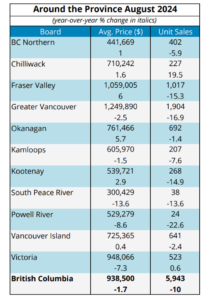
Vancouver, BC – September 11, 2024. The British Columbia Real Estate Association (BCREA) reports that 5,943 residential unit sales were recorded in Multiple Listing Service® (MLS®) systems in August 2024, a 10 per cent decrease from August 2023. The average MLS® residential price in BC in August 2024 was down 1.7 per cent at $938,500 compared to an average price of $955,063 in August 2023.
The total sales dollar volume was $5.6 billion, an 11.5 per cent decline from the same time the previous year. BC MLS® u
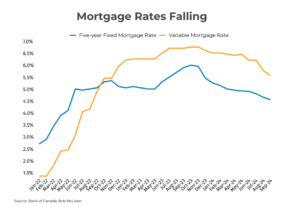
nit sales were 22 per cent lower than the ten-year average for August. “After some encouraging signs of recovery in early summer, sales slowed again in August,” said BCREA Chief Economist Brendon Ogmundson. “However, with the Bank of Canada lowering rates for a third consecutive time and with fixed mortgage rates falling, we expect market activity to pick up in the fall.”
Year-to-date, BC residential sales dollar volume is down 3.3 per cent to $50.8 billion, compared with the same period in 2023. Residential unit sales are down by 4.6 per cent year-over-year at 51,505 units, while the average MLS® residential price is up 1.4 per cent to $985,609.
Virtual Staging: Dos and Don’ts
Virtual Staging: Dos and Don’ts
It’s well-documented that staged properties tend to sell faster and for more and can either be done traditionally or virtually. So, what are some reasons you might use virtual staging? Virtual staging makes sense for properties that are vacant, pre-construction, have tenants, or have dated furniture. It’s also more cost-friendly than traditional staging.
If you decide on virtual staging, it’s important to get it right to ensure you maintain credibility with potential buyers.
Here are some must-know virtual staging dos and don’ts:
DO:
Have any repairs or updates done before the photos are taken
Use professional virtual staging services
Label each photo as “virtually staged”
Sync décor choices with the style of the property
DON’T :
Conceal or misrepresent issues or defects
Add anything other than furnishings and accessories (e.g., don’t change
the wall colour, countertops, or floors)
Discard original photos of the room
Done right, your potential buyers will be inspired by the before and afters using virtual staging. Ultimately, you want them to see themselves living there, rather than feeling like the staging is a scam.
Bidding War Battles: How To Come Out Victorious
Bidding War Battles: How To Come Out Victorious
It happens. Desirable home. Desirable neighbourhood. Multiple buyers with offers. It can be a recipe for a bidding war.
So, what do you do if you have your heart set on a home that other people want too?
Show them the cash – According to a report by Redfin, cash offers were 4 times more likely to win a bidding war. Of course, when considering making a cash offer don’t drain your emergency fund, and weigh factors such as if there is a penalty to pay if you withdraw from a certain account.
Get pre-approved – Next to cash, getting pre-approved before you shop is the next best option. This way you know what you can afford, and it ups your chances of winning a bidding war because the seller knows you are serious and can close faster.
Offer over asking – In doing so, make sure you know the highest amount you are willing to offer, thinking in terms of what the monthly payment would be.
Limit contingencies – Contingencies waived usually apply to inspections, appraisals, finances, and insurance. Be aware that waiving contingencies limits your ability to back out of the deal and you take a potentially serious financial risk.
Navigating a bidding war can be tricky, so you need to be prepared for one before it happens. As an experienced REALTOR®, that’s where I can help. If moving is on your mind, call me today.
3 Not-So-Obvious Reasons It’s Time to Sell
3 Not-So-Obvious Reasons It’s Time to Sell
There are many good reasons to put your property on the market. Some examples include a relocation, the kids leaving the nest, the need to downsize or upsize, and the list goes on.
Beyond the obvious reasons, there may be more subtle signs that the time to sell is near, such as:
1. Your Property Is No Longer a Good “Fit”
Your home may have been perfect for you when you bought it. But things change. Families grow. Needs evolve. For any number of reasons, your property may no longer be a good fit for you. If that’s the case, it makes sense to at least see what’s available on the market. Who knows? Your next “perfect” home may be for sale right now — and within your price range!
2. The Neighbourhood Is Changing
You may have been in love with the neighbourhood when you first moved in. But, over time, the characteristics of any area can change. Those changes don’t necessarily mean the neighbourhood is getting worse. It may be changing in a positive way – perhaps becoming more urban. But “more urban” may not be what you want. So, look at the direction your neighbourhood is heading. Ask yourself, “Do I still want to be living here in 2 years?”
3. You’re Ready for Your Dream Home
Remember when you purchased your current property? Did it have every feature you wanted? Was it really your dream home? Or did you have to compromise on a few things, such as the size of the kitchen? If you had to make some tough choices back then, it might be time for you to finally get the home of your dreams.
Of course, there are many other reasons it may be time to make a move. If you think now might be that time, call me today.